Sparrow
The Shrinking ManThe Sparrow is the animal threat that interrupts Scott Carey’s attempt to get away from Carey's cellar. In the snow, its repeated swoops make the open yard dangerous at Scott’s reduced scale and force him back through the cellar window. The encounter shows how an ordinary creature can become a formidable obstacle in the world his shrinking has made for him.
Appearance and Narrative Entrance
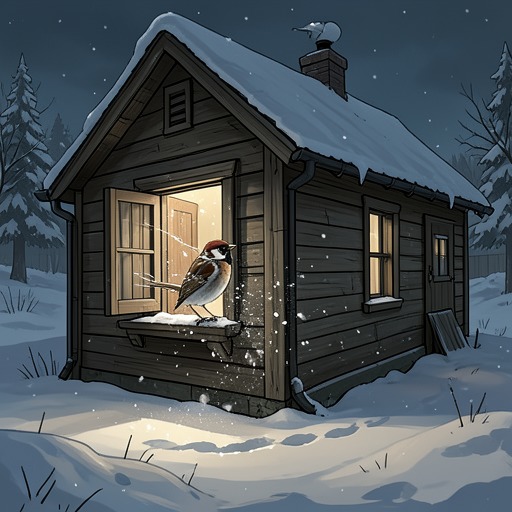
The Sparrow enters the scene as Scott reaches the corner of the house and continues toward the distant, snow-covered Ford. An object suddenly drops across the sky; the bird then circles and returns toward him. Its appearance turns Scott’s difficult crossing into an immediate contest over whether he can continue forward or must retreat.
The scene does not give the Sparrow a motive or individual history. Its role is conveyed through its actions: it approaches, circles, and attacks as Scott tries to make progress. The bird’s repeated return, rather than a single encounter, establishes it as a continuing danger throughout the attempted crossing.
Repeated Attack and Scott’s Defense
Scott tries to keep moving through the snow, but each approach brings him to his knees as he turns to ward the Sparrow off. He throws snow toward it, briefly driving it away and allowing himself to advance a few inches. The snow therefore serves both as the difficult ground he must cross and as the only immediate means of defense available to him.
That defense buys time rather than safety. Scott reaches the cellar window with his back against the house and continues throwing snow in the hope that the bird will abandon the attack. It keeps coming, however, and prevents him from making the crossing he had attempted. The scene’s rhythm is one of small advances repeatedly canceled by the Sparrow’s return.
Forced Retreat and Significance
The attack ends Scott’s attempt to remain outside. As the Sparrow continues its assault, he turns toward the open cellar window and crawls across the opening; the bird knocks him through. His escape attempt has become a retreat into the very cellar he was trying to leave.
The setback is not the end of Scott’s effort. In a later passage, back inside, he gets a drink from the hose and climbs the net’s rim toward its pole. The Sparrow’s significance lies in this reversal: a familiar bird, encountered at a radically changed scale, can determine where Scott is able to go. It briefly closes the route to escape, but does not extinguish his continuing attempts to survive.